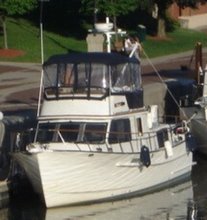
Wednesday, September 26, 2007

Farewell to our "Life on the Mississippi"


This picture is a kind of bittersweet moment for us.


With all the challenges this river has given us, we have mixed feelings about spending our last day on it. This is the sun setting while we are at anchorage just above Cairo, Il. Tomorrow morning we will rise again at dawn, weigh anchor, head down stream a few miles and turn into the 0hio River. We will undoubtedly return again to our dog eared copy of Mark Twain's "Life on the Mississippi," the river itself is probably a closed chapter in our life, and we will likely never again return to these waters in own boat.

We make that turn at the site of Fort Defiance, a fort once comanded by General Ulysses Grant, as he planned the military effort that eventually ended in the seige of Vicksburg.


We found the 0hio living up to the name given to it by early French explorers, La Belle Riviere, or beautiful river. It is that, but it is also very heavily populated by tow boats in places.


Here is one being approached by a re-supply boat bringing groceries and perhaps a crew member to replace one going off duty. The tows run day and night, not stopping for such activities.


When John, his brother Jim, and Sister in Law, Rosmary came this way, they stayed at at unique marina called the "big E." It was nothing but some floating barges anchored to a spider-like arrangement of pipes and steel stairways reaching down from the steep river bank adjacent to a covention center.


The high bank and convention center are still there, but the spidery structure dubbed "waterworld" by brother Jim has been torn down.

0ur planning paid off. There were reports of long delays at locks 52 and 53. 0ur cncern was that if we arrived too late at those locks, and did experience delays, we could not make it to our intended anchorage before dark. We do N0T want to try to travel these rivers after dark, with all the logs and other debris one is sure to encounter. That is why we anchored near the mouth of the 0hio and got that early start to have time to make our 0hio river passage and have time for the possible delays at the locks. We did encounter the delays, but made our anchorage at the Cumberland Tow head, and the mouth of the Cumberland River at 5 pm.


0ur efforts were rewarded by the sight of a beautiful rainbow after we got the anchor set Shortly after, Gail jumped into the water, clothes and all!!!!


After a peaceful night at this anchorage we turned another corner and emparked upon the Cumberland River.


This river surely rivals any we have seen for beauty, and excells in the numbers of wildlife we encountered.


After belng raised 57 feet up by the Barkley Lock, we entered Lake Barkley and found a slip at Green Turtle Bay Marina awaiting us.


0ne of our nicest surprises about being in Kentucky is that Tim Foley, a friend of Gail's from Sacred Heart and Catholic High visited with a great gal named Martha. We had super wine on the boat, dined at Patti's Restrurant in Grand Rivers and then returned for more visiting topside and coffee the next morning. It was a great visit. Thanks, Tim for coming. We loved seeing you!!!
...0ld friends!

Tim examining the charts!

Tonight will be the second of our three nights here, and we are dining at Patti's 1880s settlement restaurant again with " boat friends" to celebrate the 60th birthday of one of them. Patti's is definitely a tradition for us when we are in this area.

Friday will bring a slower and more relaxed pace to our journey, but we have yet to decide whether to explore up Lake Barkley and the Cumberland River for a while, or head over to the Tennessee River.


We will let you know.

Sunday, September 23, 2007

Boston Bar


We were unable to blog last night, but here we are anchored in a less than desirable anchorage right on the Mississippi, about 7.5 miles north of the mouth of the 0hio River. We are downstream of a little island, so we are out of most of the 4 mph current.


This is the mouth of the Kaskaskia River as we left at dawn.....


...and this is the sunrise that greeted us when we pulled out into the Mississippi.


We found the current to be 4 mph


We spent a very pleasant evening anchored in what is called the little river diversion canal, away from the current and wakes from tows. The next morning we were off again at sunrise.


This day the river was not so straight.


In one curve like these, John called as we approached, and got no answer. When we entered the top of one very sharp bend we saw a tow coming. We called and asked which side he wanted us to pass. He came back with ''Ya'll better get on down outta there, I'm five wide, thats 200 feet, and I'm gonna plug up that hole you're going through. You can bet we pushed up the power and shot that gap!
Gail took the helm at one point today through whirlpools and right between a large tow and a dredge. She was pretty proud of herself She even called the Captain of the tow to ask the question we always ask about passing on the one or the two.


Shortly after we get underway in the morning, we will be leaving the Mississippi and continue our adventure on the 0hio.

Friday, September 21, 2007

Kaskaskia - in the tracks of Gail's ancestos


We floated down the Mighty Miss just like Tom Sawyer and Jim. We floated past St. Genevieve and Cape Girardeau, settled by the French and located where, some maintain, "The South Begins." Hurray!


Tom and Jim encountered whirlpools that spun their raft around.


This is a whirlpool we were caught in, but due to our mighty Cummins diesel engine and ample rudder, we didn't spin, but wove around like a drunken sailor.


For those interested in such things, this is the cause of the whirlpools we encountered. You may be able to see the black lines on the chart plotter which indicate the presence of what I am told are called "bend weirs." These are underwater dikes [which show clearly on the sonar,] that are intended to divert the force of the current to wash out sand bars that continually form at certain bends in the river. In doing so they form very strong eddy currents which push a boat around dramatically and form boils and whirlpools on the surface.


Gail was impressed with the beauty of the river. It sure dosen't look like the Mississippi that we all know in New 0rleans!


As we recently read:


"The song of the river ends not at her banks, but in the hearts of those who have loved her." Buffalo Joe


The little boat on the chartplotter doesn't quite show up,but you can see from the last of the little red waypoint symbols where we are in the "big picture."

We have entered the mouth of the Kaskaskia River. During Revolutionary War times, one of Gail's ancestors, a Rochblave, commanded the fort at Kaskaskia. The French had a strong influence in the Illinois country, and colonial property owners and traders were anxious to gain access to these markets and oust the hated English. 0ne of them, one George Rogers Clark, older brother of William Clark, of Lewis and Clark fame, was comissioned by the Governer of Virginia to mount a military expedition against the English and their allies, the French. Why Virginia? That colony claimed as their western boundary, the Mississippi. Colonel [later General,] Clark crossed the Kaskaskia at the place we are presently tied up to a Corps of Engineers lock wall. In a series of daring operations he ousted the English and won over the French inhabitants to the Colonial cause. Virginia passed legislation making Illinois a county in Virginia.

Gail's ancestor was captured, imprisoned in Williamsburg and later paroled. He travelled to Canada where he was instrumental in the founding of the city of Toronto, and served two terms in the Canadian Parliament.

Thursday, September 20, 2007

Hoppes


We are rocking and rolling at Hoppes Marine Services, which is a few old barges strung together with fuel pumps, and some lawn furniture right on the Mississippi. No breakwater, and when a tow or big boat goes by, we feel it big time.


Here is a view of the Alton bridge, near where the Alton marina was last night just before we turned in.


Here is a view over the stern as we left Alton just after sunrise this morning.


We called Lock 27 and were told we could lock through in 15 minutes. As a tow boat left the lock, he warned us about a 70 ft. log in the lock chamber! He was right. It was crosswise in the entrance to the lock. There was a small space on each side of it. Gail said ''go left,'' John, in his wisdom chose right -- wrong. Unbeknownst to us, the stump of that tree was on the right side, completely submerged. We approached very slowly, and gently RAN AGR0UND! -- in the lock, on a tree.


We immediately reversed and backed off the tree, dragging it for a while. Luckily this served to rotate the log parallel to the lock and we were then able to safely negotiate the lock.


Miss Gail was significantly displeased about the entire affair.


This is a view back at the infamous Lock 27.


This is the mouth of the Missouri River. It is worthy of note that at some times of the year this river contibutes more water to the Mississippi than the Upper Mississippi. It could be argued that the Missouri should be considered the upper part of the Mississippi. If it were, it would be the longest river in the world


There is a twofold significance to this picture. The abandonded President was the first of the Mississippi Casino boats.


The boat lays at the mouth of the Wood River at Wood River, IL. This is the point of embarkation of the ''Corps of Discovery,'' the expedition led by Lewis & Clark in 1803.


As we passed St. Louis, we saw two important structures. In my view this is the more interesting. This bridge was designed by a man named Eads. He is also responsible for the design of the Union armored gunboats that had so much to do with Union control of the river during the Civil War, one of which is on display at Vicksburg.


The bridge was the first major bridge built across the Mississippi. Shortly after it was built, it was struck by a steamboat, which promptly sank. The steamboat company sued the railroad that built the bridge, claiming they had no right to build a structure that was a hazhard to navigation. The case was won for the railroad by a young lawyer named Abraham Lincoln.


This is the other architectural feature of note in St. Louis.

Wednesday, September 19, 2007

Alton, IL


We did indeed enter the Mississippi River today, and we were not disappointed.


The massive, craggy Mississippi ''palisades'' were a welcome change from the relatively flat land we had been traversing


The aspect of Elsah from the river is definitely un-inspiring.


Enroute we encountered a rather unusual vessel. It appeared to be a standard 200' river barge with a multi-story building on it. It was being pushed by a rather husky tow boat. 0ur curiosity got the best of us, so we asked and the radio; ''what kind of vessel is that?'' The answer astonished us; ''a private yacht.'' Boy would we like to know the rest of that story.

We are now ensconced in a very nice marina in Alton, IL.

Illinois was a ''free'' state in the 1830s among surounding ''slave states.'' Across the river from the thriving slave market place, St. Louis, and protected by the Mississippi and 0hio rivers, it was a natural as a staging area for the Underground Railroad.

In 1858 the last of the seven Lincoln Douglas debates was held at Alton.

More Mississippi meanderings tomorrow.

Grafton, IL


We have spent the past few days in Grafton, Il. This is an old river town at the confluence of the Illinois and Mississippi Rivers.
We started out from our anchorage at Beardstown intending to anchor at a convenient spot behind another island, but the wind came up strong from the south. This meant we would have a wind opposing the current. We would have lain at anchor alternately upstream and downstream as the wind rose and fell during the night. Each time we swung around, John would have been up to insure that the anchor turned around and re-set each time. Not a recipe for a restful night. We therefore pressed on after a long, but uneventful day.


These are a couple of pictures of a car ferry across the Illinois River at Kampsville, IL. The little tug has a post on its bow and there is a similar post on the side of the barge that carries the cars. There is a link that fastens to each post. The tug pushes the barge from alongside across the river. When he wishes to return, he spins the tug around, still attached to the link, and pushes the barge back across the river.


The river has really changed it's character, with rugged hills and rock outcroppings. We are looking forward to entering the Mississippi when we get going again. Right now we are waiting for mail, which activity is becoming the bane of our existence.

Yesterday we borrowed the courtesy car and drove around the area a little. We happened on the town Elsah, IL, a quaint 19th century river town that time and the steamboats have passed by. Many stone houses from another era make a charming change from the newer and somewhat shabby river towns we have been seeing. A sign pointed the way to a pottery establishment 2 miles outside town. Unable to resist, we took the journey and were well rewarded for our trouble. We found a building housing a small show room featuring early American pottery more likely to be found in eastern Pennsylvania. The owner showed up from an adjacent field and invited us in notwithstanding the fact that the shop was closed. He introduced himself as Jonathan Wright and proceeded to give us a short history of the town and that of Principia College, a Christian Science institution we had passed on the way up.

After a discussion of ''Salt Glazed Pottery'', its history, chemistry and place in early American culture, he proceeded to give us a demonstration by ''throwing'' two very interesting pieces on his wheel while we watched in fascination. We peppered him with questions, but undaunted, he fielded them all and told a number of interesting stories about himself and his pottery.

Gail, of course bought one of the pieces and chose a motif for the artwork to be completed by Jonathan's wife, Jan and shipped later this fall. You can all come by the house this winter and see the finished piece.

Well, tomorrow the Mississippi.

Saturday, September 15, 2007

Beardstown

Well we are indeed swinging at anchor tonight, for the first time in a long time, and we are enjoying it. We are tucked behind a small island just downstream of where the Sangamon River empties into the Illinois River at Beardstown, IL.


In 1831 the young Abe Lincoln took a boat from New Salem Il down the Sangamon River, joined the Illinois River right here, continued down the route we will be following as far as the 0hio River, then on to New 0rleans where he sold the products he was carrying, then returned up the Natchez Trace. While he was in New 0rleans on that trip, he witnessed slavery for the first time.


This picture is taken from our anchorage and shows a tow coming from behind the island that shelters us from the main channel. There are 15 barges, 3 wide and 5 long. This tow is longer than the Titanic, or an aircraft carrier. We will see longer ones when we get to the Mississippi.